


While visually different both bars are designed to do the same thing. The ribs on the Rebar or indentations on the Deformed Bar Anchor provide positive anchoring and both rods add tensile and yield strength to the concrete.
Where the Deformed Bar offers an advantage is weldability. The round bar stock used for Deformed Bar studs isA496/A1064 low carbon steel and offers excellent weldability. With this advantage it can be fitted with an aluminum flux ball and arc stud welded.
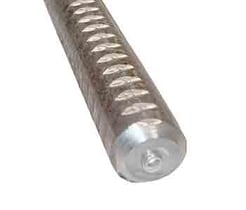 Fig. 1
Deformed Barin Weldable
Grade A496 / A1064. Shown
with aluminum flux insert
for Arc Stud Welding.
Typical Rebars, such as grade 60, 75 or 100, are not easily weldable. They are produced with a higher carbon content that increases the tensile and yield strength but decreases ductility. This will produce welds that can be brittle and susceptible to cracking.
Along with weldability, Grade A496 / A1064 steel delivers tensile strength of 80 kpi (minimum) and yield of 70 ksi (minimum)
If rebar welding is required Grade A-706 is specially formulated as a low alloy rebar designed to be welded.
Grade 60 Grade 80
Tensile 80 ksi 100 ksi
Yield 60-78 ksi 80-98 ksi
Grade A-706 rebar can be delivered in bulk or fabricated tot he specifications required including straight UNC or tapered threading.Important note : If Rebar is weldable, it will be embossed with a “W” between several of the ribs.
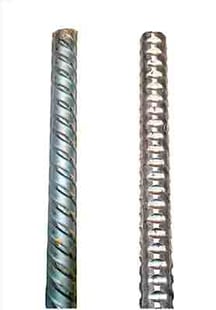 Fig. 2
Rebar and Deformed Bar.
Both are #4, or 1/2” diameter.
On the rebar shown left
there are no markings and
no “W” that would indicate
this grade would accept
standard welding procedures.
If welding Rebar or Deformed Bar is impractical based on project conditions anchoring can be done using Rebar Anchors. These can be screw-lock as shown in Fig. 3 or threaded.
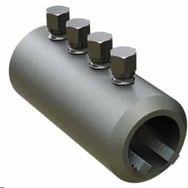
Fig, 3
Shown is the Dayton Superior
D260Weldable Rebar Anchor.
Couplers are also available
with internal threads when
required.
With any questions or RFQ’s feel free to contact a SteelSupply Company representative.
631-203-1688
info@thesteelsupplycompany.com