




Looking ahead for just a moment. The construction industry across the United States is sending out mixed signals. Focusing on Steel Construction, regarding work coming down the road in 2026 there is a good amount already underway, and more on the books.
Taking just one segment, for 2026 in the U.S., between professional and college level sports teams there are 49 new stadiums already under construction or beginning this year.
For the average professional sports stadium 16 to 20,000 tons of steel are the norm. College stadiums are more varied, due to a wide range of seating capacities, i.e. Northwestern’s Ryan Field seats 35,000 fans while University of Michigan Stadium at Ann Arbor holds 107,000. Variations notwithstanding, every new stadium, professional or college level absorbs a lot of structural steel, rebar, concrete, etc.
Due to the sheer size of these projects and the deadlines required, the primary steel fabricator will feed work to an extensive list of sub-fabricators, so opportunities exist almost everywhere, and this holds true in all construction trades.
Same with airports. At present there are 7 major airport renovations underway, each using tens of thousands of tons of steel.
Fig. 1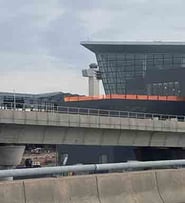
Shown is the new Terminal 6 at JFK International Airport. Aside from the soaring ceiling heights and broad clear spans common in airline terminal design, the design creates engineering challenges to retain heat, allow for structural expansion and contraction, and minimize vibration. Each new design offers ample opportunity for the sub-contractors.
From a supply chain and sub-contractor standpoint the main difference between stadium and airport projects is lifespan. Stadiums are built in compressed timeframes with hard dates focused on a season opening day. Schools function on the same principle. Conversely, airports will stay open and operational during construction. This requires them to be planned in phases causing the project to extend over long-time frames. It is not uncommon for an airport renovation to have a 10-year timeline. Approximate completion dates for the current major renovations are between 2028 and 2030. Again, pointing to healthy demand in 2026.
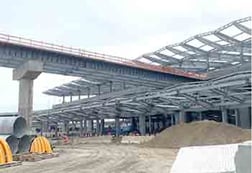 Fig. 2
The terminal shown will have
the same vaulted ceilings with
a pedestrian walkway over
what will be 3 levels of traffic.
Note: The projects mentioned are often financed at least partially by public funds, i.e. government contributions, taxpayer funded bonds, etc. For a look at private sector construction projects, view the AIA monthly report.
Major Retail space is also showing expansion and significant redevelopment. In competition to attract foot traffic shopping malls are being redesigned to accommodate mixed use, residential and public space. These renovations include some dramatic improvements such as hotels, high-end entertainment and indoor water parks. A recent review from Real Estate consultant Cushman Wakefield indicates there are currently 50 major U.S. mall renovations in various stages of planning or construction.
Each of these projects incorporates technological advances and new designs, all offering new opportunities for the contractor. The Steel Supply Company will head into 2026 with two goals in mind;
- Continue to develop and discipline our operation so you have access to the best quality products delivered on schedule at the most competitive costs available.
- Follow engineering and design advances to locate and develop new products as they come online and are designed into structures.
We are excited to see what is in store for 2026 and be part of your projects.